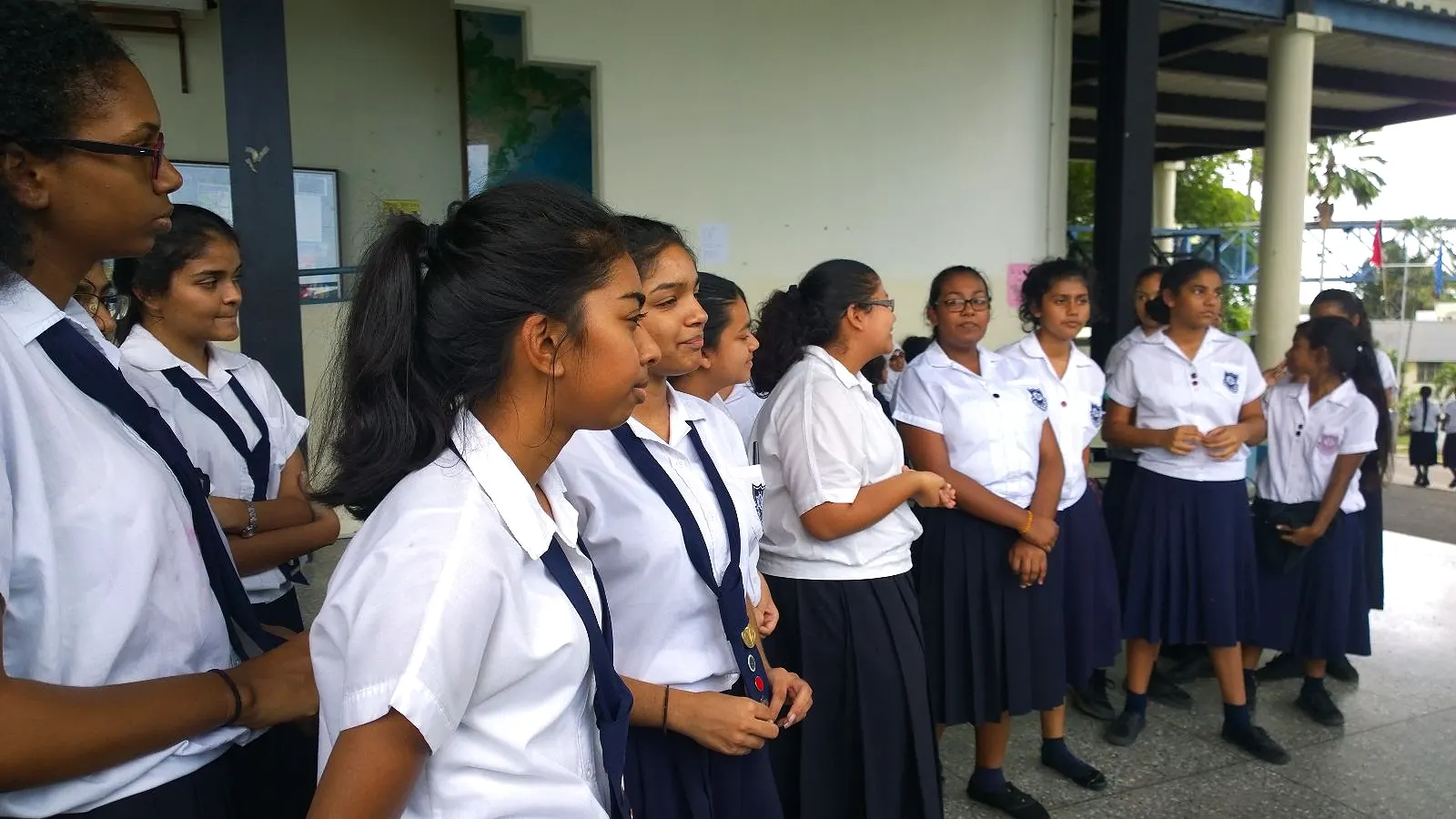
Student life
Discipline
Discipline has long been one of the foundation principles of the education received at NGHS, and continues to be an important aspect of school life. Many of our disciplinary procedures have been reviewed over time, with a view to becoming more preventative and reforming rather than purely punitive. The system aims to promote self-discipline among our students. In every case, we attempt to find the cause of indiscipline by investigating the circumstances and consulting with the family and friends of the student concerned.
Tiers of responsibility
Our system consists of a series of tiers, with a number of individuals responsible for maintaining discipline.
- Class President — a student elected by her classmates, who manages the class during unsupervised periods. She reports all matters that affect the harmonious running of the class to the Form Teacher, who takes appropriate action. The Class President assists the Form Teacher with class-related duties.
- Class Prefect — all Sixth Form students are installed as Prefects, with equal authority in monitoring the entire school population. Among them are Class Prefects, each assigned to a specific class. A Class Prefect has contact with her class at least three times a week and monitors uniform and all matters of indiscipline, serving as an exemplar, an adviser and often a mediator in class disputes. She is encouraged to develop a close relationship with those in her charge, and reports directly to the Form Teacher as well as the Dean of the year group.
- Form Teacher — the primary source of daily contact with the student, and the vital link between the school, parent and student. She is usually the first to detect that a problem exists, and initiates a process of intervention to resolve it with the cooperation of all concerned.
- Dean — each year group is assigned a Dean who, in collaboration with the Principal, Vice Principal and Form Teacher, monitors a student's academic performance as well as general behaviour and discipline. Referral forms on behaviour are used by staff. The Dean receives reports of infractions, investigates, and compiles reports on students' indiscipline. In conjunction with the Principal and parents, the Dean may refer certain cases to the Guidance Unit of the Ministry of Education or other professional agencies.
- Principal/Vice Principal — all serious disciplinary matters, as stated in Section 44 of the Education Act, that may merit suspension (for example violence, substance abuse or use of obscene language) are referred by the Principal, Vice Principal or teacher in charge to the relevant authorities (for example the police), in consultation with the School Supervisor III.
The mark system
The general aim of the mark system is to promote discipline and respect for rules, as well as to reward students for achievement in a number of areas. Commendation Marks appear on a student's report each term and are entered on the Cumulative Record Card, the child's permanent school record. The Commendation Mark is an incentive for the student to work towards excellence in academic and non-academic areas, for herself and her House.
Commendation Marks are given to students who:
- Obtain 75% or more in a subject in Forms 1–3, or 65% or more in Forms 4–6, in each subject at the end-of-term exam.
- Receive no bad marks for an entire term.
- Have perfect attendance in a term, except for students given three days' bereavement leave due to the death of an immediate family member.
- Reach the highest level of national competition in activities sanctioned by the school, such as sports, performing arts or other competitions.
Commendation certificates
These are presented to students during assembly at the beginning of each new term, as follows:
- Forms 1–3: any student gaining seven or more commendation marks.
- Forms 4 & 5: any student gaining five or more commendation marks.
- Form 6: any student gaining three or more commendation marks.
In contrast, a student may be given a bad mark by any member of staff or prefect for failing to comply with school requirements around punctuality, conduct, presentation of excuses, equipment, uniform or application. Students displaying inappropriate behaviour meet for consultation with the Form Teacher or Dean, and appropriate action is taken.
When a student is given a bad mark, the Dean is informed and the parent or guardian is called. A letter is also sent home, and the parent or guardian must sign and return it to the Form Mistress or Dean. Students receiving three or more bad marks are assigned appropriate correctional activity, and the parent is informed by letter. With the cooperation of parents, every effort is made to resolve the student's problem. Bad marks impact negatively on House performance.
Disciplinary measures
Procedures used to ensure and maintain appropriate behaviour at school:
- Consultation with teacher
- Bad marks
- Formal interview with the Dean, Principal or Vice Principal, to develop a plan for changing attitudes and behaviour
- Parent conference
- Appropriate correctional activity
- Temporary removal of privileges
- Intervention, with parental approval, of support groups
- In-house suspension
- Suspension
- Expulsion
The Ministry of Education has deemed there to be zero tolerance for:
- Smoking
- Dangerous weapons
- Alcohol and drugs
- Gambling
- Bullying and/or fighting
- Truancy
- Selling or purchasing items not authorised by administration
- Misrepresentation
- Arson
- Vandalism
- Disruptive activities
The discipline matrix
Using the guidelines of the Ministry of Education, and after consultation with teachers, parents and students, the following discipline matrix was developed as a guide. The parent or guardian is informed by the school whenever a bad mark is issued; Class and Form Teachers, Deans, the Vice Principal and the Principal may issue bad marks at their discretion.
Graduated offences
Each type of misconduct below is shown with the school's typical response to a 1st, then 2nd, then 3rd, then 4th offence.
- Violation of any school rules: consultation with teacher or visit to Dean, then visit to Dean, then parent conference, then in-house suspension or suspension.
- Unpunctuality: consultation with teacher, then consultation with teacher (bad mark, subject to consultation), then visit to Dean (subject to consultation), then parent conference (subject to consultation).
- Persistent or unexcused absence: consultation with teacher, then consultation with teacher, then visit to Dean, then parent conference.
- Skipping classes: consultation with teacher, then visit to Dean, then parent conference, then in-house suspension or suspension.
- Failure to do homework: consultation with teacher, then visit to Dean, then parent conference.
- Out of uniform: consultation with teacher, then visit to Dean, then parent conference.
- Out of bounds: consultation with teacher, then visit to Dean, then in-house suspension or suspension.
- Stealing: parent conference, then parent conference or in-house suspension/suspension, then intervention by the Ministry of Education.
- Cheating: parent conference, then parent conference or in-house suspension/suspension, then intervention by the Ministry of Education.
- Gambling: parent conference, then in-house suspension or suspension.
- Truancy: parent conference or in-house suspension/suspension, then intervention by the Ministry of Education.
- Leaving school without permission: parent conference or in-house suspension/suspension, then intervention by the Ministry of Education.
- Vandalism or graffiti: visit to Dean or parent conference, then parent conference, then in-house suspension or suspension.
- Inappropriate use of electronic media: parent conference or in-house suspension/suspension, then in-house suspension or suspension, then intervention by the Ministry of Education.
- Insubordination: parent conference, then in-house suspension or suspension, then intervention by the Ministry of Education.
- Misrepresentation or forgery: parent conference, then in-house suspension or suspension, then intervention by the Ministry of Education.
- Bullying: parent conference or in-house suspension/suspension, then intervention by the Ministry of Education.
- Obscene language or gestures: visit to Dean, then parent conference, then in-house suspension or suspension.
- Harassment: consultation with teacher or visit to Dean, then visit to Dean or parent conference, then parent conference or in-house suspension/suspension.
- Display of pornographic material: parent conference or in-house suspension/suspension, then intervention by the Ministry of Education.
- Unauthorised publication of school-related activities: parent conference or in-house suspension/suspension.
- Plagiarism: visit to Dean or parent conference, then in-house suspension or suspension.
- Disruptive behaviour or unacceptable games: visit to Dean or parent conference, then parent conference or in-house suspension/suspension, then intervention by the Ministry of Education.
Zero-tolerance offences
For the following, the response is in-house suspension or suspension, together with referral to law enforcement, from the first offence:
- Use or possession of cigarettes or alcohol
- Use or possession of drugs
- Possession of dangerous weapons
- Fighting, violence, or physical harm or the threat of physical harm to any student or staff member
- Arson
- Bomb threats or false alarms
- Use or possession of explosive devices
- Extortion